Settings
A stone’s hardness is a property of the mineral. Whether it survives ten years on a hand is mostly a property of what grips it. Read the securitycolumn first — a scratched stone is a disappointment, a lost one is a total loss. GIA is unusually direct here: asked to choose between four prongs and six, it says choose six.
16 entries
All cited
SortedA–Z
| Name | How it holds the stone | Security | Light access | Suits an active wearer |
|---|---|---|---|---|
| Bar-channel setting | Side stones sit between bars of metal rather than inside a continuous channel … | — | Allows more light to enter the side stones than a standard channel setting. | — |
| Bezel setting | A thin metal strip is pushed or hammered around the gem to hold it in place, w… | Helps prevent the centre stone from falling out, and protects the girdle again… | Allows the diamond to catch less light than a prong setting — the trade GIA st… | Yes. GIA calls it an ideal choice for an active lifestyle, and names climbing … |
| Cathedral setting | Slopes rise on either side of the stone from the band, supporting the head tha… | The slopes on either side protect the stone. | Allows the diamond to remain visible. | — |
| Channel setting | Accent stones are set into a grooved channel and laid edge-to-edge in a row. | The design protects the gemstones by keeping them flush. | Less light reaches the side stones than in a bar-channel, where the open bars … | Yes. GIA calls it ideal for daily wear and a good option for an active person … |
| Cluster setting | Several small stones of similar size are set side by side in a single head. | The more metal around a stone, the better protected it is — and a cluster need… | Maximises scintillation across the group rather than through one stone. | — |
| Four-prong setting | Four claws gripping from beneath, welded to the band. | Does not hold a diamond as securely as six prongs, and offers less protection … | Less metal on the diamond, letting the centre stone be the star of the show — … | — |
| Halo setting | Small stones are set closely around the centre stone, with prongs holding the … | The prongs holding the halo stones may wear faster than the rest of the settin… | — | — |
| Illusion setting | The stone is set into a mount of grooved white alloy whose curves catch light … | — | Works by reflection from the mount rather than by admitting more light to the … | — |
| Invisible setting | Multiple square-cut stones are set edge-to-edge so that none of the binding me… | GIA calls the setting somewhat fragile, and says so in the same breath as advi… | The whole stone is visible, and many small stones read as a single large one. | Not advisable. GIA says invisible-set stones are hard to repair or replace onc… |
| Pavé setting | A type of bead setting: the gemstone sits in a recessed hole in the mounting a… | If the wearer is extremely active the diamonds can be vulnerable to falling ou… | — | Handle with care. GIA singles out the extremely active wearer as the case wher… |
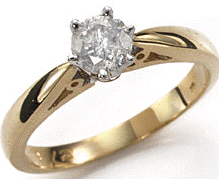 Prong setting Prong setting | Prongs act like a claw, holding the stone in place in a visually unobtrusive w… | The welded join to the band is what secures the stone. GIA treats prong count … | Prongs suspend the stone high enough off the band to show its size and detail,… | — |
| Six-prong setting | Six claws gripping from beneath, welded to the band. | Holds a diamond more securely and protects the girdle better than four prongs.… | More metal on the stone than four prongs, and more crowding on small stones — … | — |
| Solitaire setting | A single stone in a head, mounted by whichever style is chosen: prong, cathedr… | — | The prong version allows the stone to catch the most light of the popular styl… | — |
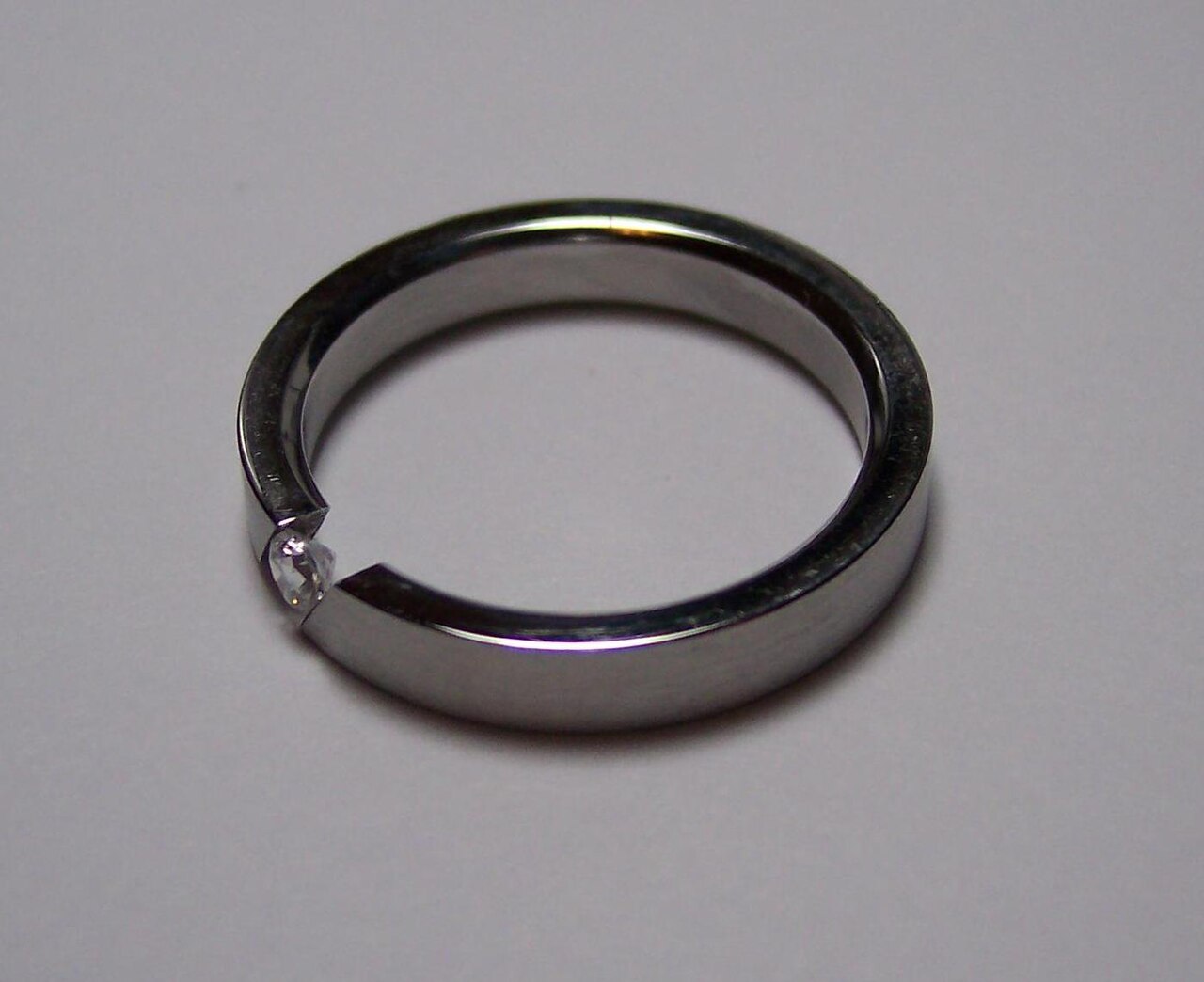 Tension setting Tension setting | The ring acts as a spring: the stone is held in place by the inherent force in… | GIA is explicit that although striking and unusual, a tension setting may be a… | There is no metal underneath the stone, so light reaches it from below as well… | — |
| Three-stone setting | A centre stone flanked by two side stones in a single mount. | — | — | — |
| V-prong setting | Prongs formed into a V so that they cup a corner or point rather than gripping… | Protects the areas most susceptible to chipping. GIA prescribes V-shaped prong… | — | — |
Showing all 16Every figure traces to a named source with a pinpoint locator. Values we could not source are left blank rather than estimated.