Prong setting
JewelryWiki Editorial·2 sources·Reviewed 2026-08-04
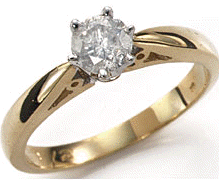
The default for a single stone. Prongs act like a claw, holding the stone from beneath with small wires welded to the band — enough metal to be safe, little enough to disappear.
Properties
| Property | Value | Authority |
|---|---|---|
| How it holds the stone | Prongs act like a claw, holding the stone in place in a visually unobtrusive way. They are small wires that bind the stone, welded to the band to ensure the stone’s safety. [1] | — |
| Security | The welded join to the band is what secures the stone. GIA treats prong count as the variable that matters — see the four-prong and six-prong entries. [1] | — |
| Light access | Prongs suspend the stone high enough off the band to show its size and detail, and allow it to catch the most light. [2] | — |
| What to watch for | Designed for single-stone or solitaire rings. The real decision is not whether to use prongs but how many — and GIA has a firm view on that. [1] | — |
Sources
- GIA — How to Decide: Four Prongs versus Six Prongs for Your Engagement Ring — Gemological Institute of America (GIA 4Cs, Four Prongs versus Six Prongs)
- GIA — Popular Setting Styles — Gemological Institute of America (GIA 4Cs, Popular Setting Styles (8 March 2011))