Turquoise
JewelryWiki Editorial·6 sources·Reviewed 2026-08-04
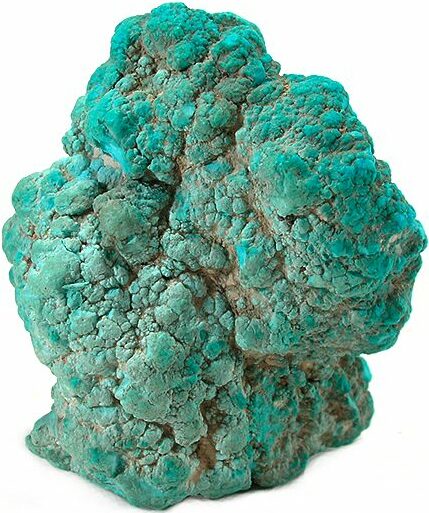
Porous and commonly stabilised or impregnated — a treatment that must be disclosed in US sales.
Properties
| Property | Value | Authority |
|---|---|---|
| Mohs hardness | 5–6 [6] | — |
| Refractive index | 1.610–1.650 [1] | — |
| Specific gravity | 2.31–2.84 [1] | — |
| Chemical formula | CuAl6(PO4)4(OH)8 · 4H2O [6] | — |
| Crystal system | Triclinic [3] | — |
| Common treatments | Frequently impregnated. The porous surface is permeated with polymer, wax or plastic, which deepens the colour and makes the material more stable — GIA’s illustration is of pale turquoise deepening after treatment. Turquoise is also among the materials dyed since ancient times. Plastic impregnation is considered durable in turquoise provided it is not subjected to heat or chemicals. [5] | — |
| Care cautions | NEVER use an ultrasonic cleaner — GIA names this among the gems susceptible to heat and temperature change, which should be kept out of an ultrasonic REGARDLESS of whether they have been treated. Use warm soapy water or a solution formulated for delicate gems. [4] | — |
| Birthstone month | December — one of three official December stones, with tanzanite and blue zircon. [2] | — |
Sources
- International Gem Society — reference charts (Mohs hardness, specific gravity, refractive index) — International Gem Society (IGS reference charts)
- Jewelers of America — Birthstones — Jewelers of America (Jewelers of America, Birthstones)
- Wikipedia — mineral article infoboxes (crystal system) — Wikipedia contributors (Wikipedia mineral infoboxes)
- GIA — Ultrasonic Cleaners for Gems: What You Need to Know — Gemological Institute of America (GIA 4Cs, Ultrasonic Cleaners for Gems)
- GIA — An Introduction to Gem Treatments — Gemological Institute of America (GIA, An Introduction to Gem Treatments (Robert Weldon))
- Handbook of Mineralogy — Mineral Data Publishing / Mineralogical Society of America (Handbook of Mineralogy, Mineral Data Publishing)