Lapis lazuli
JewelryWiki Editorial·5 sources·Reviewed 2026-08-04
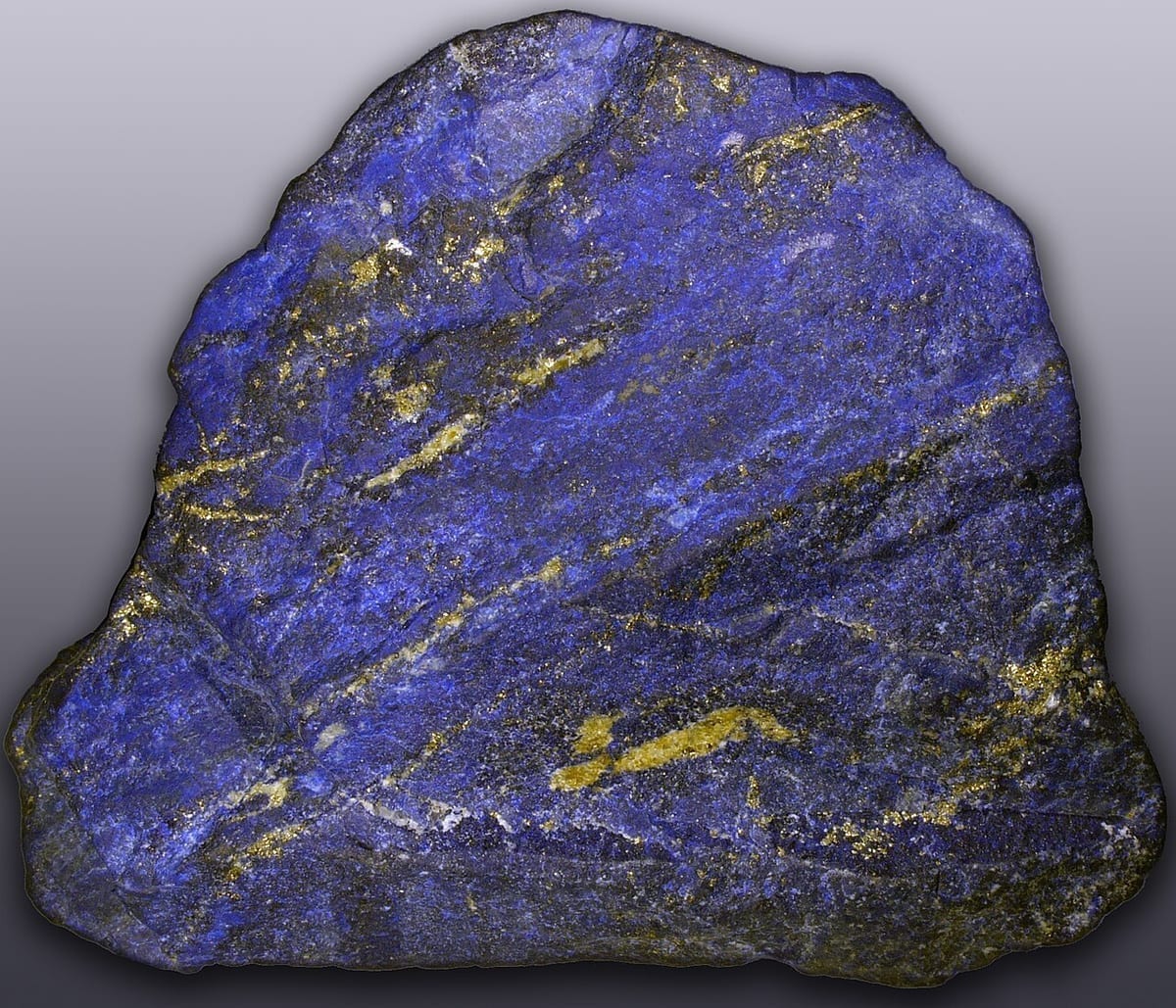
A rock rather than a mineral — mainly lazurite with calcite and pyrite. The gold flecks buyers prize are pyrite inclusions, which is why "no white, no pyrite" grading advice is contested.
Properties
| Property | Value | Authority |
|---|---|---|
| Refractive index | 1.500 [1] | — |
| Specific gravity | 2.50–3.00 [1] | — |
| Chemical formula | Na6Ca2Al6Si6O24[(SO4),S,Cl,(OH)]2 Lapis lazuli is a ROCK, not a mineral, so it has no formula of its own. This is lazurite, the mineral that gives it the blue. The rock also contains calcite and the pyrite responsible for the gold flecks, in proportions that vary from stone to stone. [5] | — |
| Crystal system | Cubic [2] Read from the species article, Lazurite. | — |
| Common treatments | Among the materials GIA records as dyed since ancient times, and among the opaque gems impregnated with wax or plastic for durability and appearance. [4] | — |
| Care cautions | NEVER use an ultrasonic cleaner. GIA names this among the gems commonly impregnated or coated with oil, plastic or wax; those treatments are not permanent and ultrasonic cleaning can strip or damage them. It is also heat-sensitive. Warm soapy water, or a solution formulated for delicate gems. [3] | — |
Sources
- International Gem Society — reference charts (Mohs hardness, specific gravity, refractive index) — International Gem Society (IGS reference charts)
- Wikipedia — mineral article infoboxes (crystal system) — Wikipedia contributors (Wikipedia mineral infoboxes)
- GIA — Ultrasonic Cleaners for Gems: What You Need to Know — Gemological Institute of America (GIA 4Cs, Ultrasonic Cleaners for Gems)
- GIA — An Introduction to Gem Treatments — Gemological Institute of America (GIA, An Introduction to Gem Treatments (Robert Weldon))
- Handbook of Mineralogy — Mineral Data Publishing / Mineralogical Society of America (Handbook of Mineralogy, Mineral Data Publishing)