Chalcedony
QuartzJewelryWiki Editorial·4 sources·Reviewed 2026-08-04
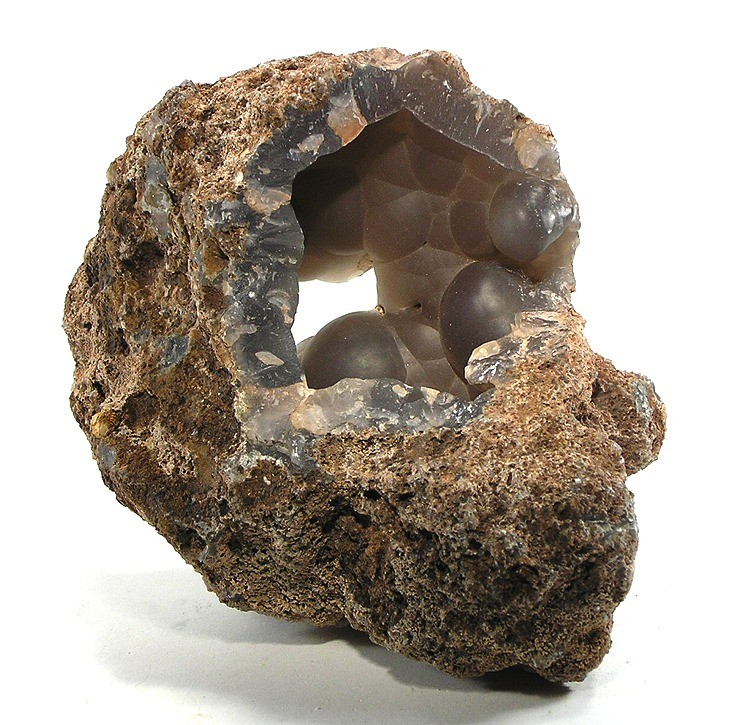
Cryptocrystalline quartz, and the parent of agate, carnelian, onyx and bloodstone. Its crystals are too small to see, which is why it looks solid where amethyst looks faceted.
Properties
| Property | Value | Authority |
|---|---|---|
| Mohs hardness | 6½–7 [1] | — |
| Refractive index | 1.530–1.540 [1] | — |
| Specific gravity | 2.58–2.64 [1] | — |
| Chemical formula | SiO2 Read from the species entry, Quartz. A variety shares its species’ formula — unlike hardness or density, which vary with composition and are not inherited here. [4] | — |
| Crystal system | Hexagonal [2] | — |
| Common treatments | Bleached to lighten its colour, and dyed — GIA illustrates a colourless chalcedony sphere dyed into a range of deep colours, and a single slice cut into sections each dyed differently. Dyeing of chalcedony is recorded as a practice used since ancient times. [3] | — |
| Care cautions | Avoid acetone and alcohol, which can dissolve the dye, and prolonged sunlight, which can fade it. GIA specifically names leaving a piece on a sunny window ledge. [3] | — |
Sources
- International Gem Society — reference charts (Mohs hardness, specific gravity, refractive index) — International Gem Society (IGS reference charts)
- Wikipedia — mineral article infoboxes (crystal system) — Wikipedia contributors (Wikipedia mineral infoboxes)
- GIA — An Introduction to Gem Treatments — Gemological Institute of America (GIA, An Introduction to Gem Treatments (Robert Weldon))
- Handbook of Mineralogy — Mineral Data Publishing / Mineralogical Society of America (Handbook of Mineralogy, Mineral Data Publishing)